CRAPPIE
FISHING
Two crappie species live throughout North America — the Black Crappie (Pomoxis nigromaculatus) and the White Crappie (Pomoxis annularis). Both are members of the sunfish family alongside largemouth bass and bluegill, and both rank among the largest panfish. Crossbreeding occurs and water clarity affects coloration, so counting dorsal spines is the most reliable ID.
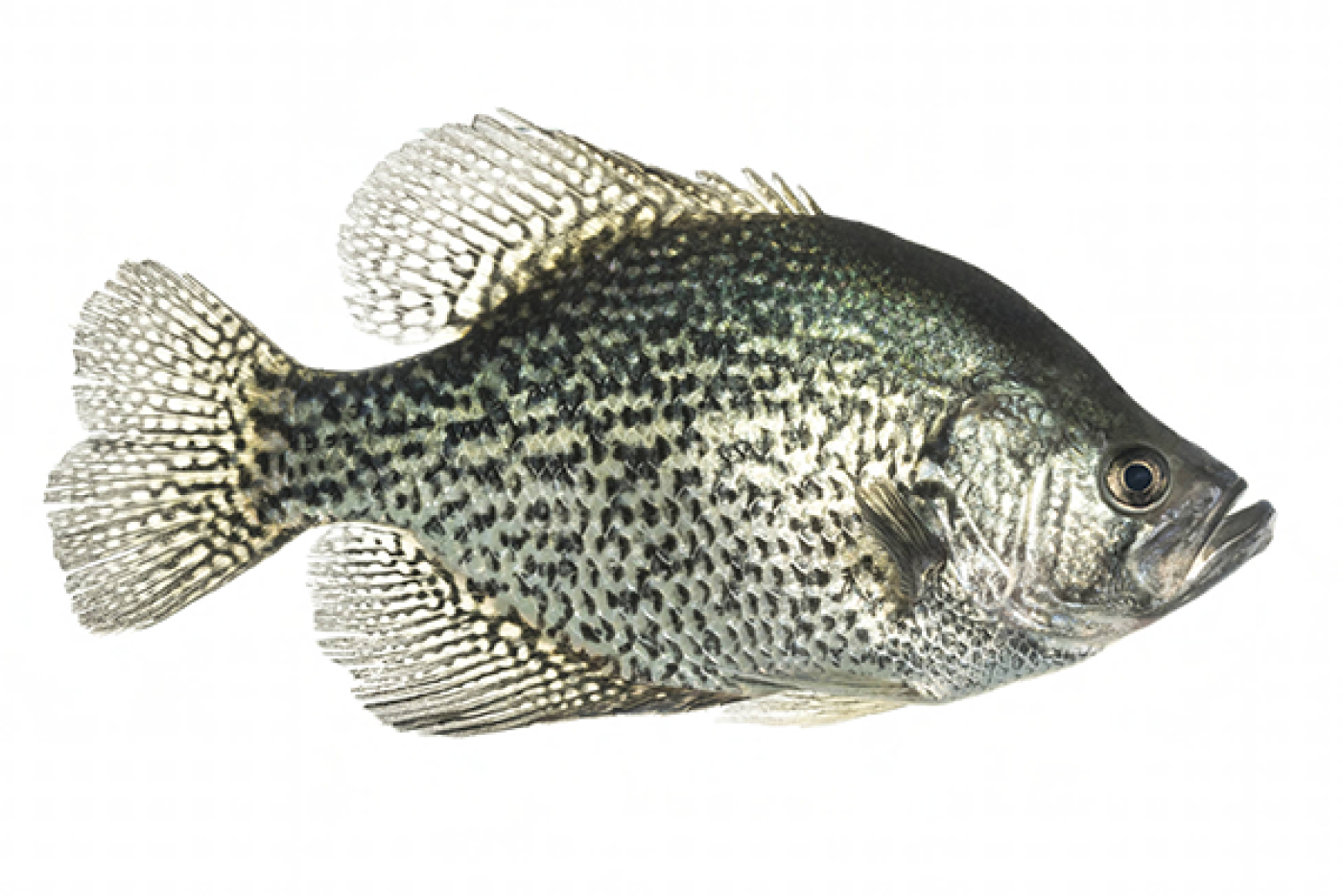
Black Crappie
Clear/Stained Water- Scientific name: Pomoxis nigromaculatus
- Classification: Game fish · Common throughout NC
- Irregularly spaced black blotches on silvery-green to yellowish sides — no defined bars
- 7–8 spiny dorsal fin rays (key ID)
- Dark green/olive back; thin, compressed body slightly deeper than white crappie
- Thrives in clear ponds, natural lakes and reservoirs with moderate vegetation; avoids turbid or murky water
- Also found in large, slow-moving Coastal Plain rivers
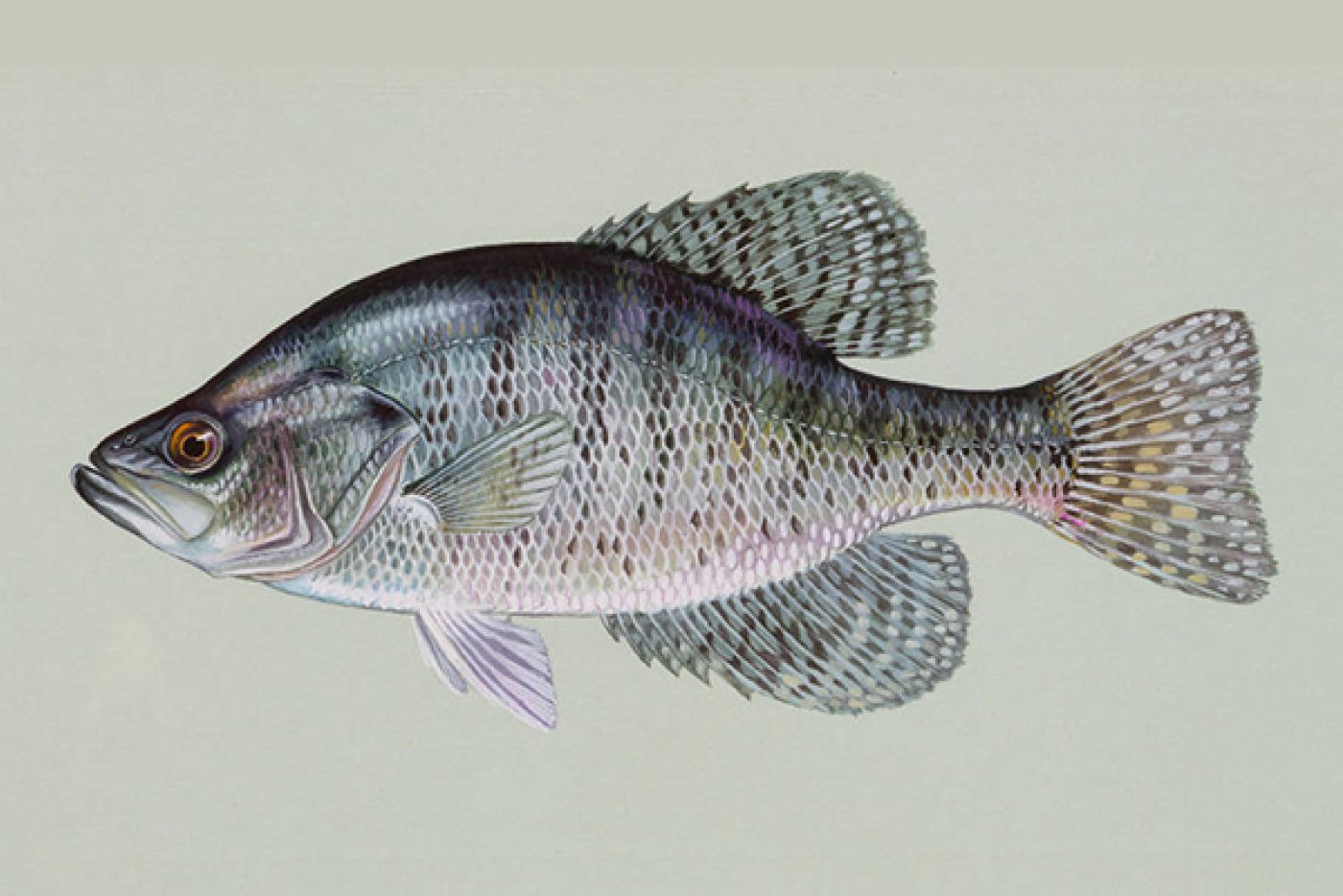
White Crappie
Stained/Turbid Water- Scientific name: Pomoxis annularis
- Classification: Game fish · Common in many Piedmont reservoirs
- Compressed, deep silvery body with green or brown shading on the back
- 5–10 dark vertical bars on each side; whitish belly;"hump-backed" profile
- 5–6 spiny dorsal fin rays (key ID)
- Not native to NC — introduced in the late 1800s and widely stocked
- Tolerates warmer, more turbid water than black crappie
- Tight to structure — fallen trees, stumps, docks, thick vegetation
- Most active at sunrise, sunset, and at night through the summer
General Biology
- Small crappie feed on insects, freshwater shrimp, and nymphs; larger fish switch to small baitfish and larger insects
- Spawn at 56–68°F — earlier than bass, usually March–April in the Piedmont
- Paper-thin mouths — light wire hooks, no hard hooksets
- School tightly by size; slabs tend to stack deeper than smaller fish
- 10"+ is a quality fish in NC; 12"+ is a slab
- State record NC: 4 lb 15 oz
Species descriptions adapted from the NC Wildlife Resources Commission.
Pre-Spawn (Feb–Mar)
Water 48–56°F. Fish begin staging on secondary points and channel edges near spawning flats. Best early-season window — fish are aggressive and actively feeding before the spawn push. Target 6–12 ft.
- Focus on the first significant depth change adjacent to spawning areas
- Brush piles on 8–12 ft flats are money
- Small swimbaits and 1/16 oz jigs under a slip float
Spawn (Mar–Apr)
Piedmont Peak: Late March – Mid AprilWater 56–68°F. Fish move shallow to nest — often 1–6 ft over hard bottom, gravel, or near brush. Males guard nests; females are catchable nearby in slightly deeper water.
- Docks, standing timber, shallow brush, rip-rap banks
- Pink, white, and chartreuse dominate during spawn
- Slow presentations — let the jig hang in the strike zone
Post-Spawn / Early Summer (May–Jun)
Fish scatter and recover. Tougher bite for a few weeks. Transition to deeper structure and suspended fish following shad schools.
Summer (Jun–Aug)
Fish suspend 12–25 ft, often relating to thermocline and baitfish concentrations. This is the hardest season for crappie without electronics. Find the bait on sonar and the crappie will be near it.
- Spider rigging and long-line trolling most effective
- Deep brush piles (placed by locals) hold fish all summer
- Early morning and evening bite near docks and standing timber
- Live minnows outperform plastics in mid-summer heat
Fall (Sep–Nov)
Water temps drop, shad move shallow, crappie follow. One of the best action windows of the year. Fish are aggressive and chasing bait in the 6–15 ft range. Target creek channel mouths, points, and bridge pilings.
- Match the shad — silver, white, and pearl colors shine
- Casting small swimbaits and crappie cranks under docks
- Bridge pilings stack fish during fall migration
Winter (Dec–Feb)
Fish slow down and move deep — 20–35 ft on main lake structure. Not dead — just deliberate. Vertical jigging with tiny presentations directly on structure. Best mid-day when water warms slightly.
- Tiny 1/32–1/16 oz jigs, very slow fall
- Live minnows most reliable in cold water
- Find concentrations with electronics — winter fish school tight
- Rocky main lake points, channel bends, deep brush
Brush Piles
The #1 crappie magnet in Piedmont reservoirs. Locals sink brush piles in 8–20 ft of water and guard the locations closely. If you find a pile, you've found fish.
- Mark every brush pile you find — GPS them immediately
- Cedar trees and pine tops hold fish best long-term
- Fish all sides and at multiple depths — fish may suspend above the pile
- Many Piedmont reservoirs have an extensive culture of sunken brush; dock owners often know locations
Docks & Piers
- Best year-round except mid-winter
- Shoot docks with a jig and float to reach shaded back corners
- Older wooden docks with crossbeams and attached brush are best
- Cast parallel to the dock rather than perpendicular
Standing Timber
- Critical on reservoirs where timber was left standing when the lake was flooded
- Fish tend to suspend at a consistent depth along a tree line
- Work vertically — drop to fish's depth, then use a tight horizontal presentation
Creek Channels & Ledges
- Channel bends with 8–15 ft adjacent to shallows are prime staging areas
- Pre-spawn and fall both see heavy channel edge use
- Old road beds and ditches visible on lake maps hold fish
Bridge Pilings
- Concentrate fish during fall migration
- Fish both the shaded and sunny sides depending on season
- Multiple depth ranges — work from bottom up to find the school
Rip-Rap Banks
- Dam faces and road causeways warm faster in spring — key pre-spawn areas
- Baitfish concentrate here; crappie follow
Lower a jig directly below the boat onto brush piles, timber, or structure. Most precise technique. Control depth exactly. Deadstick with occasional lifts. Especially deadly in winter when fish won't chase.
Slip float or fixed bobber above a jig or live minnow. Set depth at 1–2 ft above the structure or bottom. Fan-cast around docks and brush. Best for precise depth control when fish are suspending. Slip floats allow casting heavy enough to reach distance while keeping jig light.
- Slip float: 3/8–1/2 oz oval; set stop knot at desired depth
- Thill Crappie Cork or Thill Shy Bite — most sensitive options
- Jig 6–12 inches below float for very shallow fish
Slingshot a jig under low dock overhangs using an underhand pendulum cast. Reaches fish that won't come out for a standard presentation. Requires practice — use ultralight spinning gear and 1/16 oz jigs. Most productive in spring when fish are tucked under docks.
Multiple rods (6–12) spread off bow of boat, trolling slowly at 0.5–1.5 mph over structure. Covers water to find suspended fish. Each rod targets a different depth or color. Deadly when fish are scattered across a flat or suspended over a channel. Specialized crappie rods 10–16 ft.
Troll jigs or crappie cranks 30–50 ft behind the boat on light line over open water. Targets suspended fish that aren't relating to structure. Works best when shad schools are visible on sonar. Let out line until jig depth matches the bait depth.
When nothing else works. Hook minnow through the back just behind the dorsal. 1–3 ft below float. Let it swim naturally. Most effective in cold water, post-front conditions, and mid-summer heat. Use a #4 or #6 Aberdeen light wire hook.
A parallel approach to everything above. The iFish system — popularized by Victor at i_fish / ifishtackle.com — imports Japanese ultralight (JDM) crappie tactics: hair-thin mono, weight-matched floats, and micro jigs on wire-thin hooks. Where the American method leans on bobbers, split shot, and swivels, the iFish method removes every drag point until the float rides dead-flat and telegraphs the faintest tap. Use it side-by-side with the traditional techniques above — same fish, different vocabulary.
The BG-1 Micro Jig Lineup
Flagship jig. Flat head accepts soft plastics without a hook keeper. Thin Japanese-wire hooks with a micro barb — one hook routinely lands 50+ fish. Start with #10 for crappie (#12 for bluegill, #8 for larger crappie or mixed bass).
| Model | Weight | Hook | Best Use |
|---|---|---|---|
| BG-1 EcoLiteLead-free, slow-sink | 0.6 g | #12 | Tiny ponds, ultra-clear water |
| BG-1 EcoLite | 0.75 g | #10 | Finesse, clear water, pressured fish |
| BG-1 EcoLite | 1.2 g | #8 | Deep slow-sink EcoLite option |
| BG-1 StandardUniversal | 1.0 g | #10 / #12 | Most versatile crappie weight |
| BG-1 Standard | 1.25 g | #10 | Open water, moderate depth |
| BG-1 StandardiFish"Perfect Crappie Jig" | 1.5 g | #10 / #8 | Prime confidence weight |
| BG-1 Standard | 2.0 g | #8 | Distance casting, deep winter, wind |
Dressing the Jig
Run the hook straight through the dead center of the plastic — off-center kills the horizontal action. Micro-serrated scissors for trimming. Tiniest drop of super glue on the wire shank, thread plastic on, rotate to spread.
| Plastic | Prep | Best Scenario |
|---|---|---|
| Trout Magnet1" | Keep full body (clip first section for bluegill) | Best all-around |
| Leland's Crappie Magnet1.5" | No trim | Larger crappie, clear water |
| Euro Tackle EPF Swim1" | Full body | Active fish, faster retrieve |
| Berkley PowerBait1" | Remove the two big flaps by hand; keep tail | Cold water — scent matters below 50°F |
| Simon Larva Z | Cut off molded eyes (eyes deter fish) | Active fish, great tail action |
| Charlie Brewer Slider1" | Cut off first section | Finesse, finicky fish |
Fixed vs. Sliding Floats
The critical distinction in the whole system. It's not just about depth — it's about how the jig moves.
| Fixed (F-series) | Sliding (S-series) | |
|---|---|---|
| Motion on twitch | Float travels with jig (horizontal) | Float stays put — jig rises vertically |
| Depth range | 2–6 ft (rod-length limited) | 5–20+ ft |
| Best for | Shallow spawn, grass flats, structure edges | Deep winter, thermocline, dock pilings |
| Setup | Thread both silicone tube loops | Stop knot above + optional stopper bead below |
Fixed Float Setup
- Thread mainline through both silicone tube loops on the float stem (bottom to top).
- Tie the BG-1 with a loop knot, or clip on via micro clip for quick swaps.
- Match float to jig exactly — F100 → 1.0 g, F125 → 1.25 g, F150 → 1.5 g.
- Cast, let jig sink to target depth, then twitch. Float and jig travel together.
- No split shot. No swivels. If more weight is needed, add a 0.25 g olive sinker.
Sliding Float Setup
- Thread mainline through the metal eye first, then the plastic eye on the float stem.
- Tie the upper stop knot: 0.30–0.40 mm braid, uni knot with 8–9 wraps. Leave tags long. Do not overtighten — must be hand-adjustable.
- Optional: one silicone stopper bead 1–2 ft above the jig so the float doesn't slide all the way down on the cast.
- Tie BG-1 with loop knot or micro clip.
- Set depth by sliding the stop knot. Always wet the line first.
- Cast, let jig descend. Float tilts when the stop knot hits it — then twitch.
Technique 1 — Float Twitching (primary method)
A slow-drifting jig stays in the strike zone for close to a minute; a swimbait passes through in two seconds. Two non-negotiable rules:
- The fish has to be able to eat it. Don't twitch so wildly the crappie can't intercept. Small movements —"writing a letter in the air," mostly straight-line.
- Pause after every twitch. The bite comes on the fall or on the dead stop, not on the move.
Technique 2 — Float Trolling
S125 or S150 sliding float set to target depth (typically 4–10 ft) with a 1.25–1.5 g BG-1. Troll 0.5–1.0 mph — faster and the jig rises, slower and it dead-sticks. Cover long stretches of points, timber lines, and creek channel edges. In current, let the float drift naturally and control boat speed with the trolling motor. F/S 200 Big Floats with orange caps for long-distance visibility.
Technique 3 — Minnow Pairing
Soft plastics carry the system, but minnow-tipped BG-1 excels in cold water and under heavy pressure.
| Hook Style | Placement | When |
|---|---|---|
| Nose-hook | Through lower then upper lip | Most natural swim; best for moving presentations |
| Back-hook | Under dorsal — minnow hangs head-down | Stationary vertical presentations |
| Lip-hook (through body) | Most secure — hard to throw off | Short strikes, strong current |
Line & Reel Spec
| Component | Spec | Note |
|---|---|---|
| Mainline | 0.15–0.16 mm mono (~3–4 lb) | Victor's optimal range |
| Stop knot | 0.30–0.40 mm braid | 8–9 wrap uni; slides through guides cleanly |
| Leader (optional) | Slightly thinner mono below the float | Breaks before losing the float on a snag |
| Jig knot | Loop knot preferred | Free swing = maximum action |
| Reel | Shimano Sahara 500/1000 or Daiwa Legalis LT1000 | 1000-size body, smooth drag at featherweight settings |
Credit: methodology adapted from Victor (@i_fish) and ifishtackle.com. Their BG-1 jigs, F/S-series floats, and olive-sinker system are the reference implementation.
Tube Jigs & Curly Tails
| Lure | Weight | Best Use |
|---|---|---|
| Bobby Garland Baby Shad2" swimbait body | 1/16–1/8 oz | Vertical, float — all-season standard |
| Bobby Garland Slab Hunt'R2.25" | 1/32–1/16 oz | Dock shooting, finesse |
| Strike King Mr. Crappie Shadpole2" | 1/32–1/16 oz | Cold water, finesse vertical |
| Leland's Crappie Magnet1.5" | 1/64–1/32 oz | Ultra-finesse, cold water, winter |
| Leland's Slab Curly2" curly tail | 1/16 oz | Brush piles, all-around |
| Berkley Gulp! Alive Minnow1–2" | 1/32–1/16 oz | Float fishing, tough bite |
Swimbaits & Hard Baits
| Lure | Size | Best Use |
|---|---|---|
| Bandit 200 Crankbait | 2" | Long-line trolling, casting |
| Rebel Wee-Craw | 1.5" | Rip-rap, rock banks |
| Bobby Garland Baby Shad Swim'R | 2.25" | Trolling, open water |
| Rapala Ultra Light Crank | 1.5" | Casting, dock edges, fall |
Piedmont Color Notes
- Stained arms & coves: Chartreuse, yellow, orange, and pink dominate — go bright
- Clearer main lake: White, pearl, smoke, natural, and blue outperform
- Spawn period: Pink/white and red combinations are top producers regardless of clarity
- Fall shad bite: Silver, white, and pearl to match the bait
Rod & Reel Combos
Reel
Line
- Mono (best for beginners): 4–6 lb Stren Original or Trilene XL — forgiving, floats, easy to manage
- Fluoro (clear water): 4–6 lb Seaguar Red Label — less visible, sinks faster, good for deep jigging
- Braid + Fluoro leader: 8–10 lb braid main line / 6 lb fluoro leader — best sensitivity combo for deep brush
Hooks (Live Minnow)
- #4–6 Aberdeen light wire hook — light wire prevents bending on light line, easy to remove
- Eagle Claw Plain Shank Aberdeen — pack of 100 under industry standard
- Mustad 3261 Aberdeen — premium version, sharper out of the box
Reading Sonar for Crappie
Crappie show up differently than bass. They school tight and often suspend off structure. Key things to look for:
- Arch clusters: Tight groups of arches at a consistent depth = suspended school
- Snow on sonar: Dense baitfish (shad) clouds — crappie will be on the edges or just below
- Hard returns near brush: Fish holding in or just above the pile
- Suspended lines: At a depth cutoff — often marks the thermocline
Lowrance / Humminbird Settings
- Use 2D sonar at medium sensitivity — high sensitivity creates false echoes in warm water
- Down Imaging or SideScan to locate brush piles, timber, and structure before dropping a line
- Zoom in bottom 1/3 of water column in summer to see suspended fish detail
- Split screen: 2D + Down Imaging side by side works well for crappie
Livescope / Forward Sonar
Forward-looking sonar (Garmin Livescope, Humminbird Mega Live) is used extensively by serious crappie anglers for dock shooting and locating schools. Watch jig fall in real-time. Game-changing for brush pile and dock presentations if you have it.
Marking Brush Piles
- Drop a waypoint immediately when you get a fish off a pile
- Name waypoints with depth and date found
- Private brush = local fishing culture. Don't crowd someone else's marked pile. Move on.
Filleting Crappie
- Sharp fillet knife (6–7" flex blade) — dull knives waste meat and increase injury risk
- Cut behind the pectoral fin down to the spine; turn blade flat and run along the spine to the tail
- Flip fillet skin-side down; run blade between skin and meat at the tail end
- Check fillets for the Y-bone — in larger crappie a small rib section can remain. Cut a thin V-notch to remove.
- Rinse in cold water; pat dry; use immediately or pack in water and freeze
Classic Beer Batter Crappie
- 1 cup flour + 1 tsp garlic powder + 1 tsp seasoned salt + 1/2 tsp black pepper + 1/2 tsp cayenne
- Mix dry ingredients; whisk in one cold beer (lager) until batter is thin pancake batter consistency
- Heat vegetable oil to 375°F in cast iron or Dutch oven
- Dip fillets in batter; fry 3–4 minutes until golden — do not overcrowd
- Drain on wire rack; hit with kosher salt immediately out of the oil
- Serve with coleslaw, hush puppies, and hot sauce
Simple Pan-Fried (Cornmeal)
- 1 cup yellow cornmeal + 1/2 cup flour + 1 tsp salt + 1 tsp Old Bay or Cajun seasoning
- Dip fillets in buttermilk, then dredge in cornmeal mix
- Fry in 1/2" of oil in a cast iron skillet at medium-high heat, 2–3 min per side
- Classic Southern preparation — lets the fish flavor come through more than beer batter
Storage
- Fresh fillets keep 2 days refrigerated on ice; 6 months frozen in zip bags with water
- Vacuum sealed: 12+ months in freezer with no freezer burn